It has become the default playbook for enterprise restaurant brands and multi-location QSRs: If we want to own our customer data and bypass third-party delivery commissions, we need our own app. For the last half-decade, restaurant executives have poured millions of dollars into custom mobile application development. The boardroom pitches were alluring. An app would supposedly create a direct channel to the consumer, build unbreakable brand loyalty, and serve as a proprietary engine for first-party data.
Yet, for the vast majority of restaurant brands today, the reality is starkly different.
The app sits in the iOS and Android stores, gathering digital dust. Maintenance costs continue to bloat IT budgets. And when marketing teams look at the analytics, they see a depressing, undeniable pattern:
Building your own app is not the solution. For most restaurants, the lifecycle is simple: Download once, used for 1 discounted order, and deleted within weeks.
The hard truth facing the industry in 2026 is this: Building your own app is not the solution to your customer retention problem. Restaurants do not need more standalone technology taking up space on a customer’s phone. Instead of begging customers to download a clunky app, modern brands are shifting their focus to frictionless ecosystems—specifically, Apple Wallet and Google Wallet.
Here is why your restaurant app is failing, and how modern brands are abandoning software builds in favor of building habits.
The "Download, Order, Delete" Cycle
To understand why the custom restaurant app is failing, we have to look at the friction inherent in the modern consumer’s digital life. We are living in an era of severe app fatigue. The average smartphone user only uses about 9 apps daily, and the vast majority of those are social media, messaging, and utility applications.
When a customer walks into your restaurant or visits your website, asking them to download a 150MB application just to order a burger or earn a few points is a massive ask. To overcome this friction, marketing teams rely on the oldest trick in the book: the bribe.
"Download our app today and get 20% off your first order!"
It works, temporarily. The customer, standing at the counter or browsing on their couch, downloads the app to get the discount. They complete the transaction. But what happens next?
Unless your brand is a daily necessity, that app immediately becomes dead weight on their device. It sits on the fourth page of their home screen, occasionally firing off an annoying push notification that is swiftly ignored. A few weeks later, when the user’s phone alerts them that their storage is almost full, your restaurant app is the very first thing to be deleted.
You paid a massive Customer Acquisition Cost (CAC) to get that download. You subsidized their meal with a discount. And in the end, you gained nothing but a single, transactional data point that leads to a dead end.
The Frictionless Alternative: Apple & Google Wallet Loyalty Cards
This is why forward-thinking brands are abandoning the custom app in favor of native digital wallets. Instead of a high-friction app download, imagine a frictionless enrollment journey.
As seen in the example below, a customer simply scans a QR code on their coffee or an in-store display. They enter their phone number on a lightweight, branded web page, and instantly—without downloading a single app—their new digital loyalty card is saved directly to their native Apple or Google Wallet.
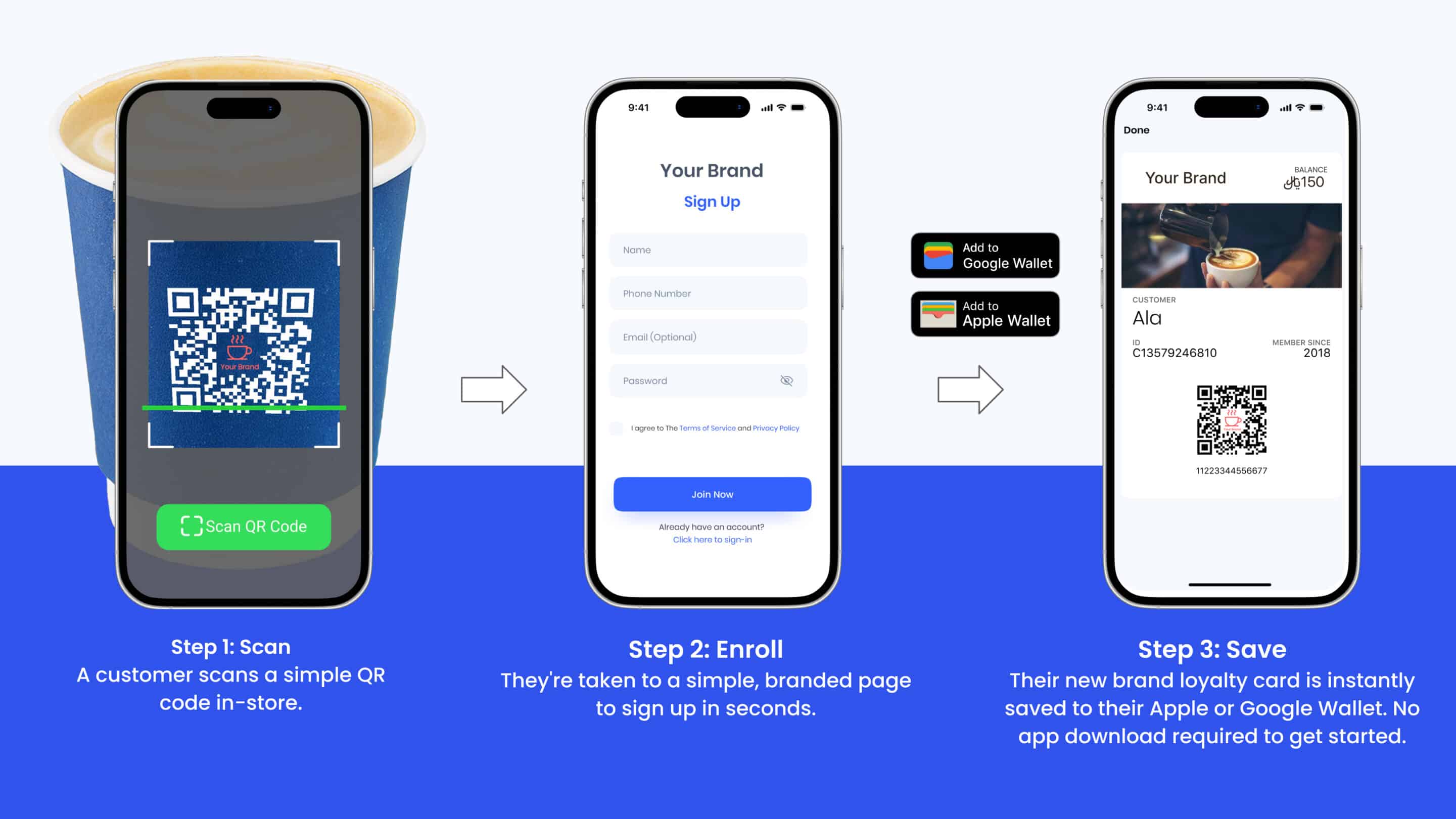
The digital loyalty card stays in the one app the customer actually opens every day: their wallet. It utilizes built-in location services to pop up on their lock screen when they walk past your store, and it requires zero IT maintenance from your team.
The Core Misunderstanding: Apps Don’t Create Loyalty, Habits Do
The fundamental flaw in the "build an app" strategy is a misunderstanding of what loyalty actually is.
Many executives conflate software usage with brand affinity. They assume that if a customer has the app, they are loyal. But technology does not create loyalty. Habits create loyalty. Think about the most cited example in restaurant tech: the Starbucks app. For years, brands have tried to replicate it, assuming the app itself was the magic bullet. But Starbucks did not build a multi-billion-dollar digital flywheel because they had great software; they succeeded because their software attached itself to an existing, daily habit. People drink coffee every single morning. The app merely removed the friction (payment and waiting in line) from a behavior that was already deeply ingrained.
If your restaurant sells premium burgers, high-end dining, or specialty desserts, your customers are not visiting you every single morning. Your frequency is naturally different. Forcing a high-friction app into a low-frequency relationship is a recipe for failure.
True loyalty is an emotional and behavioral connection. It is the customer choosing your brand over a competitor on a Friday night without even thinking about it. That kind of habitual behavior is formed through consistent, positive, and deeply personalized interactions—not through a piece of software living on a phone.
The Anatomy of a Habit
In behavioral psychology, habits are formed through a simple loop: Cue, Craving, Response, and Reward.
If you want to build a habit around your restaurant, you need to master this loop:
- The Cue: It’s 5:00 PM on a Thursday, and the customer is leaving the office, feeling tired.
- The Craving: They want something comforting, fast, and familiar for dinner.
- The Response: They order from your restaurant.
- The Reward: They receive a delicious meal, exceptional service, and perhaps a personalized perk updated instantly on their Apple Wallet card.
An app only facilitates the Response. It does nothing to trigger the Cue or satisfy the Craving unless it is powered by intelligent, predictive data. Sending a generic "Buy One Get One" push notification to your entire app user base on a Tuesday morning is not a Cue; it is spam.
To build a habit, you must anticipate the customer's needs before they even unlock their phone.
The "More Tech" Fallacy and the Siloed Data Crisis
When faced with low app adoption, the typical corporate response is to throw more features at the problem. Let's add a gamified spinning wheel! Let's integrate a third-party delivery tracker! Let's redesign the UI!
This is the "More Tech" fallacy. Restaurants do not need more technology. In fact, most multi-location brands are already drowning in it.
Walk into any modern QSR or enterprise restaurant, and you will see a fractured technological landscape. There is the Point of Sale (POS) system. There is the Wi-Fi capture portal. There is the online ordering platform, the table reservation system, the third-party delivery aggregators, the email marketing software, and, yes, the custom mobile app.
The problem is not a lack of technology; the problem is that none of these systems talk to each other.
Customer data is trapped in isolated silos. The POS knows what a customer bought, but not who they are. The email software knows what campaigns a customer opened, but not if they actually came into the store to buy anything. The app knows what the user browsed, but it loses visibility the second they order through a third-party aggregator instead.
When you build a custom app without fixing your underlying data infrastructure, you aren't solving a business problem. You are just building another silo.
You don't need another silo. You need a unified system that synthesizes all of this fragmented data into a single, actionable view of your customer.
What Restaurants Actually Need: Intelligence Over Infrastructure
To drive predictable revenue and repeat orders, restaurant brands must shift their mindset from "App-Centric" to "Customer-Centric."
Instead of trying to force customers to download an app they don't want, you must meet them exactly where they already are. You need an omnichannel approach that engages customers via SMS, WhatsApp, Email, and native digital wallets, all powered by a centralized brain.
This is the philosophy behind modern, enterprise-grade revenue engines like Qubriux. We realized early on that restaurants were fighting a losing battle by focusing on software infrastructure rather than customer intelligence.
To win in today's highly competitive market, multi-location brands need three foundational pillars:
- 1. A Unified Data Core (QubCore): Before you can engage a customer, you have to know them. You need a system that integrates seamlessly with your existing tech stack, pulling data from your POS, e-commerce platforms, loyalty programs, and Wi-Fi portals to consolidate it into a single customer profile.
- 2. Predictive AI (QubMind): Once your data is unified, you cannot rely on manual analysis. A true AI engine doesn't just show you past sales; it predicts future behavior, learning the unique purchasing frequency of every individual customer. It takes the guesswork out of marketing, telling you exactly who to target and when to send it.
- 3. Automated, Omnichannel Engagement (QubEngage): Finally, you need a way to reach the customer without forcing them to download an app. With an intelligent messaging layer, you can execute AI strategies automatically across WhatsApp, SMS, and native digital wallets—channels your customers actually use.
Stop Funding Digital Real Estate, Start Funding Revenue
Building and maintaining a custom restaurant app in 2026 is an expensive vanity project. It looks great in a board deck, but it fails to address the root cause of customer churn.
Your customers do not want your app taking up space on their phones. They want convenience, recognition, and value. They want you to remember their favorite order, reward them for their continued business, and engage them through the channels they already use every day—like their Apple or Google Wallet.
It is time to stop burning marketing budgets on app install campaigns and forced downloads. The future of restaurant loyalty belongs to the brands that focus on data, not downloads.
By unifying your fragmented systems, leveraging AI to understand individual customer behavior, and automating personalized outreach across SMS, WhatsApp, and digital wallets, you can transform your operations. You stop guessing, you stop discounting blindly, and you start engineering the one thing every restaurant actually needs: predictable, repeat revenue.
About Qubriux
Qubriux is a comprehensive, AI-driven revenue engine built specifically for multi-location restaurant brands and QSRs. We solve the industry's biggest data challenges by unifying fragmented POS, e-commerce, and loyalty systems into one actionable platform. Our predictive AI acts as an always-on strategist, automatically triggering personalized engagement across WhatsApp, SMS, and native digital wallets. We empower enterprise brands to move beyond generic apps and costly discounts, helping them build true customer habits and drive predictable, repeat revenue.
Book a Demo