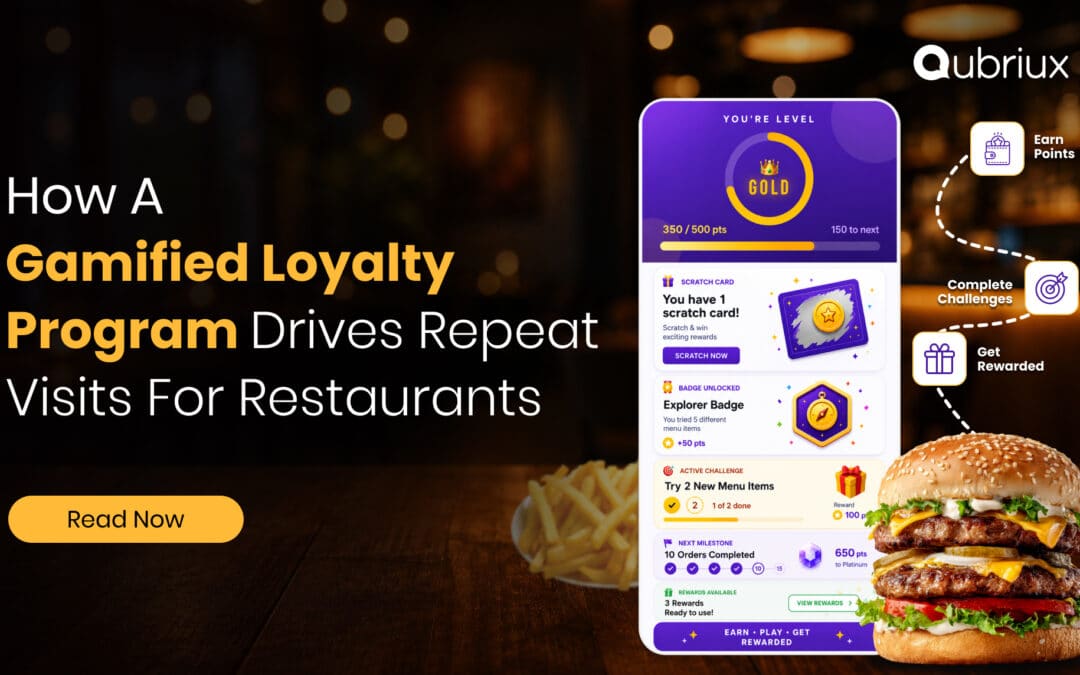
Multi-unit brands win repeat visits when they replace forgettable punch cards with a habit loop customers actually enjoy. A well-designed gamified loyalty program turns routine ordering decisions into moments of visible progress, and when guests see momentum building toward a reward, they come back to protect it.
Industry data consistently shows that programs adding gamification report roughly a 47% lift in engagement and a 22% increase in brand loyalty. A 2024 press release report by Gartner confirms that digital marketing leaders must leverage experiential benefits and gamification throughout the end-to-end customer journey to increase loyalty program retention and grow revenue. That translates to measurable lifts in visit frequency, retention, and margin-aware revenue.
This article is a practical playbook. You will select three to five mechanics that fit your brand, map a phased rollout, and lock in the KPIs that prove incrementality. Platforms like Qubriux co-create custom rules with your team and run the program end to end, so you are not boxed into one-size-fits-all tools that ignore your visit cadence or margins. We will cover why gamification works across multi-unit portfolios, which mechanics to use, how to design for lasting habits, a rollout roadmap, the KPI stack that matters, and how to choose a platform capable of real-time data and quick iteration.
The Business Case for a Gamified Loyalty Program in Multi-Unit Brands
What the data says: credible uplifts you can model
The engagement and retention figures cited across loyalty gamification research are directionally consistent. Research from McKinsey & Company indicates that next-generation personalization and customer-centric engagement can yield significantly higher retention, highlighting that emotional engagement accounts for up to 65% of brand differentiation in saturated markets. Mastercard case examples add further weight, pointing to signals such as six-times purchase frequency for participants in the first year and double the normal campaign engagement among enrolled members.
Use these as directional guardrails, not guaranteed outcomes. Results vary by mechanic fit, offer economics, and execution quality, which is why testing and incrementality measurement are non-negotiable. Run holdouts, track revenue lift by margin band, and make changes quickly when mechanics underperform. Gamification in loyalty programs lifts engagement and retention measurably, but outcomes scale only when mechanics match your actual visit cadence.
Why multi-unit brands benefit more than most verticals
Retail and food brands operate with high-frequency SKUs, multiple dayparts, and impulse-driven decisions. That combination makes the category nearly ideal for challenge loops, streaks, and points-and-badges mechanics that deliver quick feedback at the counter or in-app. When customers see visible progress and attainable milestones, they return to keep a streak alive or complete a collection. To protect profitability, pair the game layer with a margin-aware rewards economy. Mix soft benefits like priority pickup with targeted boosters that nudge trial of add-ons or new categories. The goal is movement on visit frequency and average check, not a race toward deeper discounts.
Examples to Inspire: Gamified and Proven Programs
Starbucks-style stars and tiered unlocks create long-term progression with constant near-goal motivation. Chipotle-like streaks and short missions can spike weekday traffic or drive cross-daypart trial. Spin-to-win and scratcher formats have shown strong results in adjacent verticals: slot-machine-style mechanics deployed by hospitality brands have doubled engagement in documented case studies, and a daily scratcher format used in one app-based travel program logged an approximately 80% return rate among active users.
Recent brand-specific examples reinforce the pattern. The KFC UK Rewards Arcade reported that 31% of customers used the app more frequently after the feature launched. Papa Johns' game-style campaigns showed higher app installs, stronger retention among engaged members, and meaningful average order value lift. A Cheba Hut arcade game inside its loyalty app correlated with a 36% year-over-year increase in loyalty sales. Blend instant wins with deeper progression so novelty and depth stay in balance; that combination keeps casual members engaged while rewarding your most loyal customers.
Choose Your Game Plan: Designing Mechanics
Challenges and time-boxed missions
Define clear missions that match your menu and dayparts. Strong examples include try two new menu items this month, visit across breakfast and lunch this week, or add a side and a beverage twice in 10 days. Keep two to three challenge templates per quarter with variable difficulty and rewards sized to margin, so you can rotate without fatigue. Make acceptance explicit and track completion for clean KPIs. This lets you compare cohorts that accept missions against those who skip them, then optimize triggers, copy, and incentive values. Time-boxed challenges create crisp cause-and-effect relationships you can actually measure using AI-driven personalization.
Streaks that build dependable habits
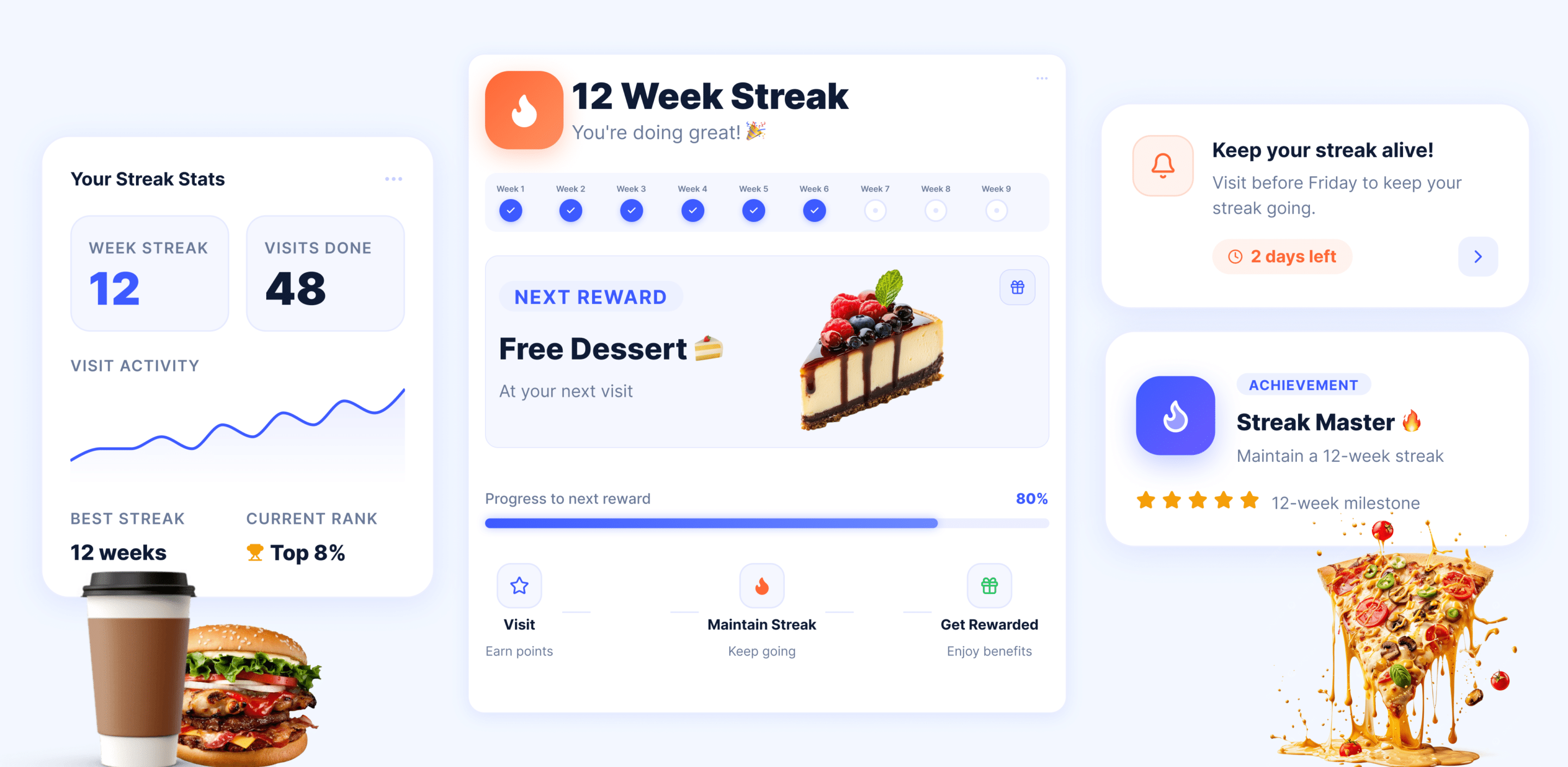
Use daily, weekly, and monthly streaks depending on your baseline visit frequency. Add grace periods and forgiveness rules to protect motivation when life gets in the way. A missed Tuesday might be recoverable by Friday, and a monthly streak can tolerate one skip with a catch-up visit. Support streaks with well-timed app notifications and at-register prompts. Tie rewards to behavior value rather than just visit count. Rewarding a weekly combo purchase streak more than a single-item streak, for example, guards margins while reinforcing the habit you actually want to build.
Badges and status that customers want to collect
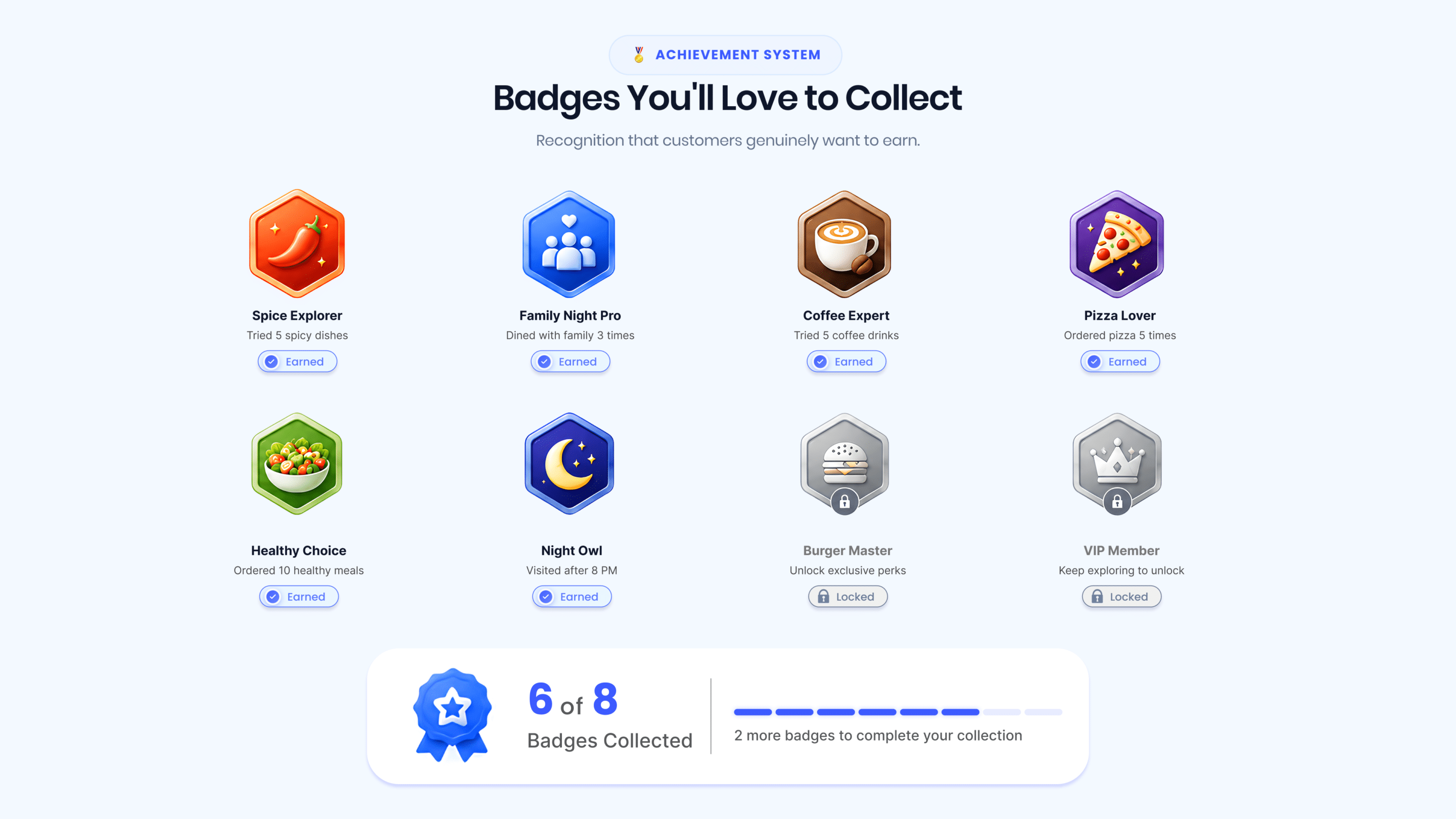
Design collection badges and seasonal sets that map to your brand identity. Think Spice Explorer, Family Night Pro, or a limited summer series that encourages category exploration. Badges work as non-monetary recognition that still nudges visit frequency and basket mix. Offer optional social sharing and profile displays as light social proof, keeping it brand-safe and focused on delight rather than pressure. Recognition that feels genuinely earned can move behavior without raising your discount cost.
Tiered unlocks and VIP moments
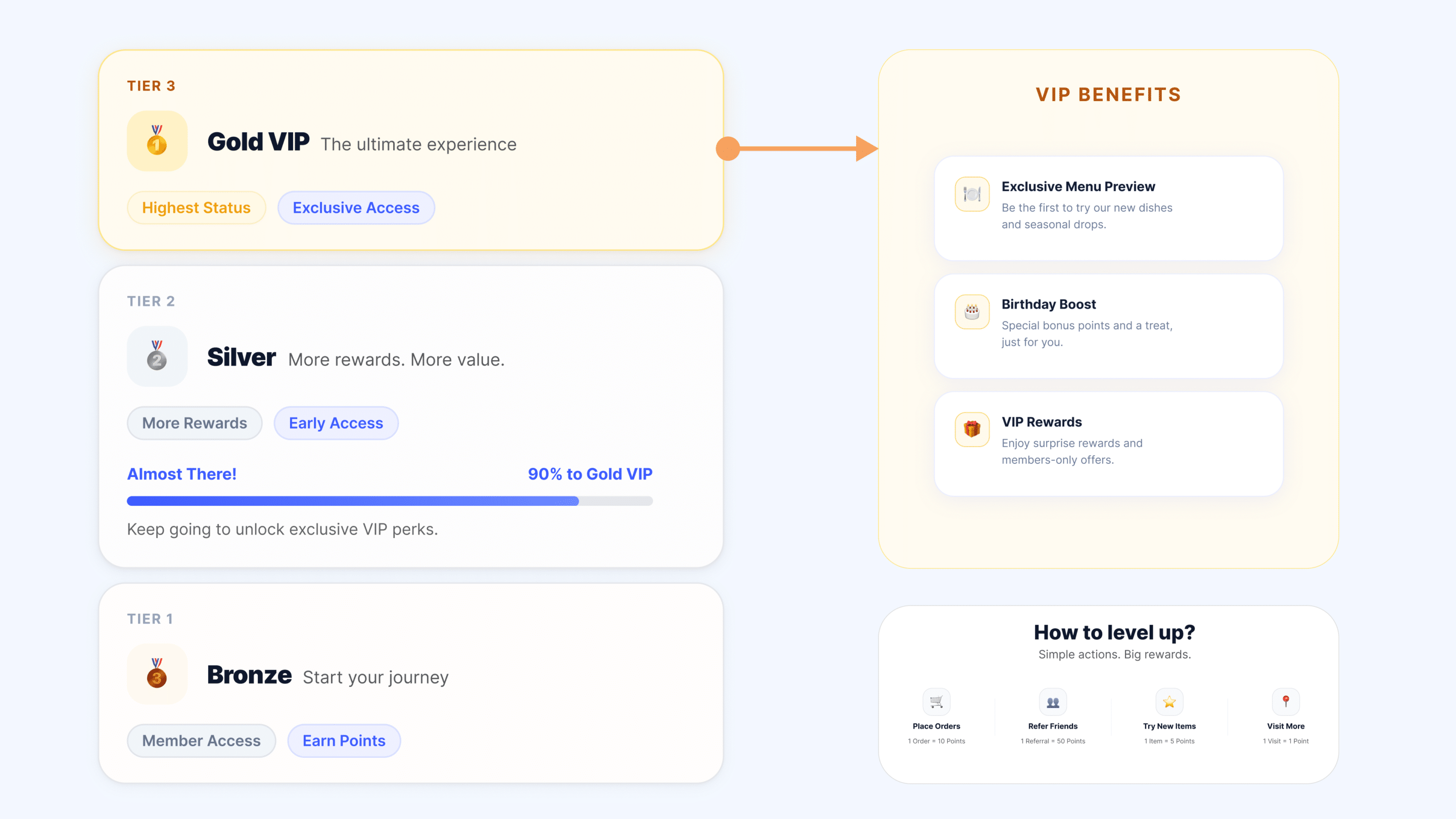
Set up progressive tiers that emphasize perceived status and convenience. Benefits like priority pickup, surprise menu previews, birthday boosts, or chef table drops can feel premium without heavy cost. Add accelerators near thresholds to leverage the goal gradient effect, so members push toward the next level as they get closer. Keep the reward economy simple and transparent. If a member cannot estimate the payoff in seconds, they will not trust the climb. Publish rules in plain language and show exactly which actions move them closer to the next tier.
Design for Habits, Not Gimmicks: UX and Behavioral Rules
Variable rewards without chaos
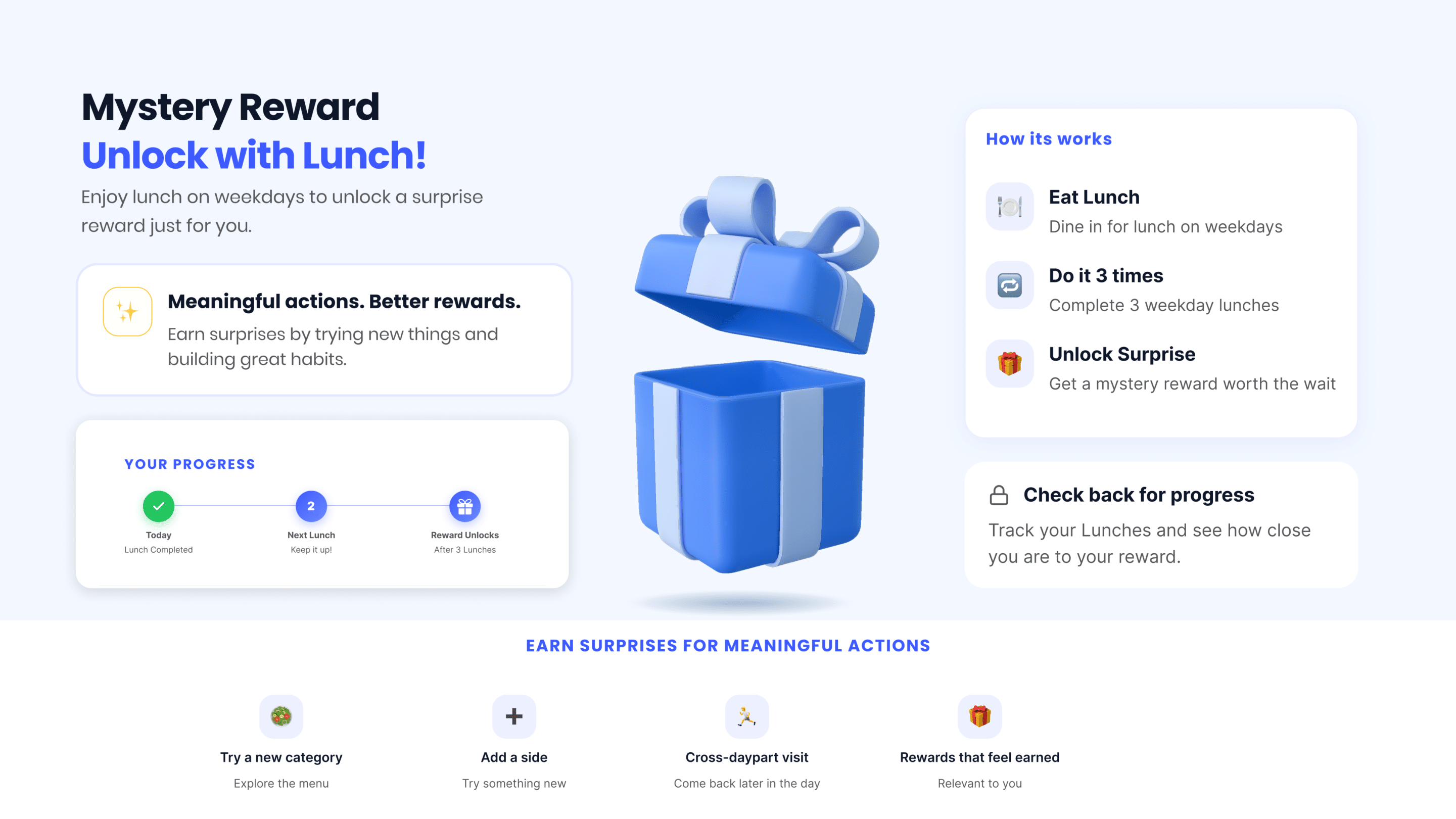
Use probabilistic bonuses tied to meaningful actions like trying a new category, adding a side, or completing a cross-daypart visit, instead of random spins that train members to wait for discounts. Balance fixed and variable rewards so the experience feels fresh but still predictable. A mystery multiplier unlocked after three weekday lunches is more effective than a daily lottery that burns budget and erodes trust. Every reward should feel earned and relevant to that member context.
Progress visibility and the goal gradient
Show progress bars, next-step hints, and near-goal nudges in receipts, the app home screen, and order confirmation messages. As members approach a badge or tier, offer small near-miss boosts to raise motivation. Keep the math legible so customers can estimate their payoff quickly; if progress is easy to see, effort feels worth it. Designers can follow the behavioral economics principles highlighted by the Harvard Business Review when building these cues. Hide the mechanics, and participation drops.
Social proof built for retail and enterprise
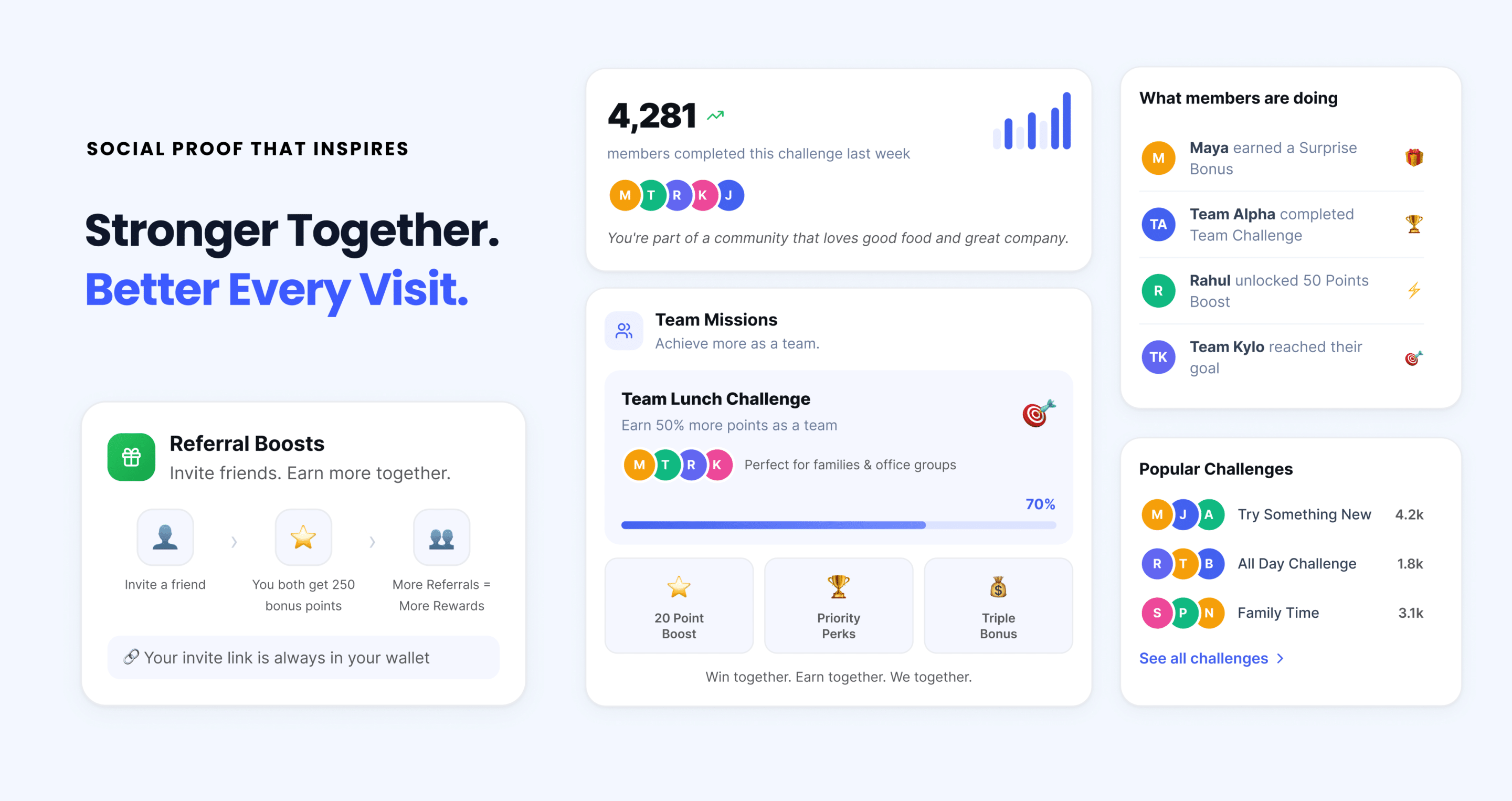
Use lightweight cues like "4,281 members completed this challenge last week" to validate choices without leaderboards that shame lower-activity users. Add referral boosts and team missions designed for families or office groups to lift average check and frequency together. Keep sharing optional and consistent with your brand voice.
Pitfalls to avoid
Over-discounting, too many concurrent missions, and unclear rules that flood your support team are the most common failure modes. Watch for equity issues across locations and franchisees by standardizing core rules and allowing only pre-approved local variants. Plan for accessibility, clear opt-outs, and data privacy compliance to protect trust and reduce regulatory risk. Clarity, consistency, and consent beat novelty every time.
From Idea to Chain-Wide Rollout: A Practical Roadmap
Data foundation that keeps scores accurate
Unify POS, kiosk, app, online ordering, and existing loyalty data so challenges and streaks update in real time at every location. A Customer Data and Engagement Platform like Qubriux centralizes identity, cleans transaction data, and keeps rules synchronized across channels. Confirm SMS, email, and push consent flows before you turn on automation. Clean data de-duplicates members, links anonymous orders to known profiles, and prevents the "I completed the mission but did not get credit" frustration that kills program trust early. No clean data, no game. To optimize this step, explore how to maximize your guest database.
Pilot with discipline, then scale
Run 8 to 12-week pilots across varied markets and dayparts with control groups or geo holdouts. This window is long enough to let novelty effects settle, accumulate statistical power, and work through POS integration edge cases. Limit your initial test to three to five mechanics that map directly to goals like weekday lunch traffic or add-on attach rate. A/B test reward values and triggers, then define a scale-up gate based on visit frequency lift, healthy redemption, and incremental revenue. Document learnings weekly and retire any mechanic that drives redemptions without measurable incrementality. Winning programs are edited aggressively.
Train teams and enable the floor
Equip staff with one-sentence explanations, quick prompts, and a simple cheat sheet. Use in-store signage, QR codes, and receipt callouts so joining and tracking progress takes seconds. Give teams scripts for when a member breaks a streak, so staff encourage recovery rather than apologize for the rules.
Compliance, liability, and finance alignment
Work with finance early on reward funding, liability recognition under ASC 606, and breakage assumptions tied to actual redemption patterns. Align on accrual policies and disclosures before launch. Set a monthly governance cadence to review rule changes and keep the reward economy sustainable over time.
Measure What Matters: KPIs, Benchmarks, and Incrementality
The KPI set for engagement-driven loyalty:
- Enrollment, activation within 60 days, monthly active members.
- Challenge participation, streak retention, badge completions.
- Redemption rate, points issued vs. redeemed, effective discount rate.
- Visit frequency, average order value, customer lifetime value, churn, win-back rate.
- Reward cost per incremental visit, location-level incrementality, NPS.
Make challenge and tier metrics visible by cohort and by location. Manage the reward economy like a P&L, not a campaign. That mindset shift is what separates programs that scale from programs that stall.
Benchmarks to calibrate targets
Use engaged member rates of 40 to 70% monthly and activation above 60% within 60 days as healthy reference targets. For NPS, aim above +40 as a signal of genuine program affinity. On redemption: note that the 60 to 80% redemption benchmark cited in some enterprise loyalty literature comes primarily from tightly controlled B2B programs and may not translate directly to consumer contexts. In most multi-unit retail programs, redemption typically sits around 15 to 25%. A well-executed gamified loyalty program tends to raise redemption and lower breakage relative to a basic stamp card, so track reward cost per incremental dollar closely to protect margins.
Proving incrementality and optimizing offers
Use geo holdouts, matched cohorts, or randomized eligibility for specific mechanics to isolate true lift. Tie uplift to revenue, not just clicks, and segment results by margin band to avoid celebrating expensive wins. Refresh mechanics quarterly based on what moves customer lifetime value rather than vanity engagement metrics. Recent findings by Forrester emphasize the critical importance of linking customer experience innovations like gamification directly to financial outcomes to sustain executive support.
Cadence and visibility for operators
Run weekly mechanics-health huddles and monthly ROI reviews with finance. Publish location-level dashboards so general managers can see participation, redemption, upsell outcomes, and any guest friction in real time. Standardize a change log for rule adjustments and retire underperformers quickly.
The Platform Decision: Custom Rules and Real-Time Data
What to require from your gamified rewards program stack:
- A flexible rules engine for challenges, streaks, badges, and tiers with real-time scoring.
- Deep POS, kiosk, app, and online ordering integrations with identity resolution.
- Omnichannel messaging across email, SMS, WhatsApp, and push with behavioral triggers.
- Location-level analytics, incrementality testing, and safe rollout tools like geo holdouts.
- Liability controls, breakage modeling, and audit-ready reporting for finance.
- Fast iteration without vendor tickets for every rule change.
Why Qubriux is built for gamification at scale
Qubriux is a unified Customer Data and Engagement Platform built for multi-location brands. QubCore is designed to unify POS, kiosk, app, loyalty, and online ordering data into a single member identity that updates in real time across locations. QubMind, the platform's autonomous AI engine, is built to predict churn risk, optimize incentive values, and personalize engagement by cohort and location, without requiring additional headcount to manage the complexity.
The Qubriux team co-creates custom game mechanics and loyalty rules alongside your team, then measures true incrementality at the store level. Customers using the platform to run structured gamification programs have reported improvements in repeat visit frequency and member retention, with reward economics and margin awareness built into the program design from day one. The goal is a platform relationship that functions as a strategy partnership, not just software access.
Migration and integration without disruption
Qubriux integrates with major POS systems and messaging channels using a data-hygiene-first approach. Straightforward rollouts often move from kickoff to pilot launch within a few weeks, while complex multi-brand or multi-market configurations take longer depending on integration scope. The member experience stays stable as new rules roll out in phases, with analytics and consent frameworks live before full-funnel automation begins.
A 90-day launch playbook:
- Weeks 1 to 3: Define goals, map audience cohorts, and select three to five mechanics aligned to dayparts and margin bands.
- Weeks 4 to 6: Configure rules and real-time instrumentation, wire up omnichannel journeys, and finalize pilot creative.
- Weeks 7 to 12: Launch pilots across varied markets with holdouts, monitor lift, tune incentives, and complete staff enablement.
- End of week 12: Greenlight chain-wide scale if visit frequency, redemption health, and incremental revenue clear defined gates.
A gamified loyalty program built around challenges, streaks, badges, and tiered unlocks turns occasional visitors into regulars. The difference between a gimmick and a growth engine is a clean data foundation, disciplined pilots, and KPIs that prove incrementality so gains compound over time. Select your core mechanics, choose a rollout track, and align finance on a rewards economy designed to improve margins as the program matures.
Qubriux is ready to partner on both strategy and execution, helping you design the rules, unify your data, and automate engagement across every channel with clear proof of incremental revenue at each location. If you want a loyalty engine your members love and your finance team respects, the conversation starts here.
About Qubriux
Qubriux is a unified Customer Data and Engagement Platform built to help multi-unit brands drive measurable, incremental revenue. By connecting POS, loyalty, and digital ordering data, Qubriux gives operators a single, accurate view of their guests. Using AI-driven intelligence (QubMind), the platform automates personalized marketing, churn prevention, and gamified loyalty campaigns that protect margins and increase lifetime value without requiring large internal teams.