

Many multi-unit brands are sitting on a mountain of behavioral data they never actually use. POS transactions, loyalty accruals, app sessions, order history by daypart, it is all there. The problem is that raw data does not tell you who is about to stop coming in, who is ready to spend more, or when to reach a customer for maximum impact. That is exactly what predictive customer analytics and intelligence are built to do. In fact, research from Gartner outlines that organizations must transition from a data-driven to a decision-centric vision, making decision intelligence platforms essential for success.
Customer behavior prediction is not a data-science vanity project. When it works, it translates directly into churn prevention, higher visit frequency, and margin-aware offers that do not leak revenue. In published case studies and internal benchmarks, multi-location brands report churn reductions of roughly 15 to 30 percent and revenue uplifts of 3 to 5 percent after shifting from broadcast promos to prediction-driven activation. According to McKinsey, companies that push incremental sales through targeted promotions can see a 1 to 2 percent lift in overall sales and a 1 to 3 percent improvement in margins. The move from generic promotions to acting on predictive signals is one of the clearest, nearest-term revenue levers available to multi-unit brands.
This guide explains how the core models work, what data you actually need, how to run a 90-day pilot, and which KPIs prove value to both marketing and finance teams. Along the way, we show where predictive analytics for customers fits in your tech stack and how to avoid the most common measurement traps.
Inside the models: churn, next visit, and spend propensity
Attrition risk and churn prediction is usually the fastest win. The algorithm tracks recency, frequency, and monetary trends alongside service signals, then assigns each customer a risk score by time horizon. The practical output is a prioritized list of people whose behavior is slipping before they fully lapse. For retail and food brands especially, customers who drift several days beyond their normal cadence are far more likely to disengage, which makes early intervention a priority.
Next-visit prediction adds a timing dimension that many operators underestimate. The model estimates each person's likely return window by daypart and day of week, so your outreach lands in a short window, often within a few days, of when they are statistically likely to visit anyway. That timing matters: a relevant message that arrives when purchase intent is already high converts far better than a generic Tuesday blast. Set per-channel frequency caps and respect contact preferences to avoid overwhelming customers across every touchpoint.
Spend propensity models take the logic one step further by forecasting how a customer will respond to upsell and cross-sell paths, not just discount offers. The model uses item affinity, daypart behavior, and customer lifetime value forecasting to identify margin-safe add-ons for each person. This is the difference between personalized predictive marketing and blanket promotions: one protects your contribution margin, the other erodes it.
On the modeling side, XGBoost—an optimized distributed gradient boosting library designed for efficiency, flexibility, and portability—with RFM features like recency, frequency, and monetary value plus tenure and engagement signals consistently delivers strong churn performance on tabular transaction data. Logistic regression remains a clean baseline for interpretability. For CLV forecasting where right-censoring matters for active customers with incomplete lifetime histories, survival analysis is a more defensible default because it accounts for customers whose stories are not yet finished, rather than artificially truncating their predicted value.
Predictive modeling for CX: churn, timing, and spend
All three use cases regarding attrition, next-visit timing, and upsell propensity are examples of predictive modeling for CX. The throughline is simple: prioritize the right person, with the right offer, at the right time, then measure the incremental effect rigorously. Utilizing targeted promo propensity predicts the likelihood of a customer making a purchase based on their behavioral history, leading to better satisfaction and protected margins.
The data foundation: what you actually need
The transactional backbone from your POS is where everything starts. Item-level tickets, order source, timestamp, discounts applied, and payment type form the core features for RFM modeling and margin analysis. Consistent location codes matter enormously here because they enable both individual customer scoring and location-level performance comparisons, which is non-negotiable for multi-unit brands. To learn more about organizing this structure, read how to maximize your guest database.
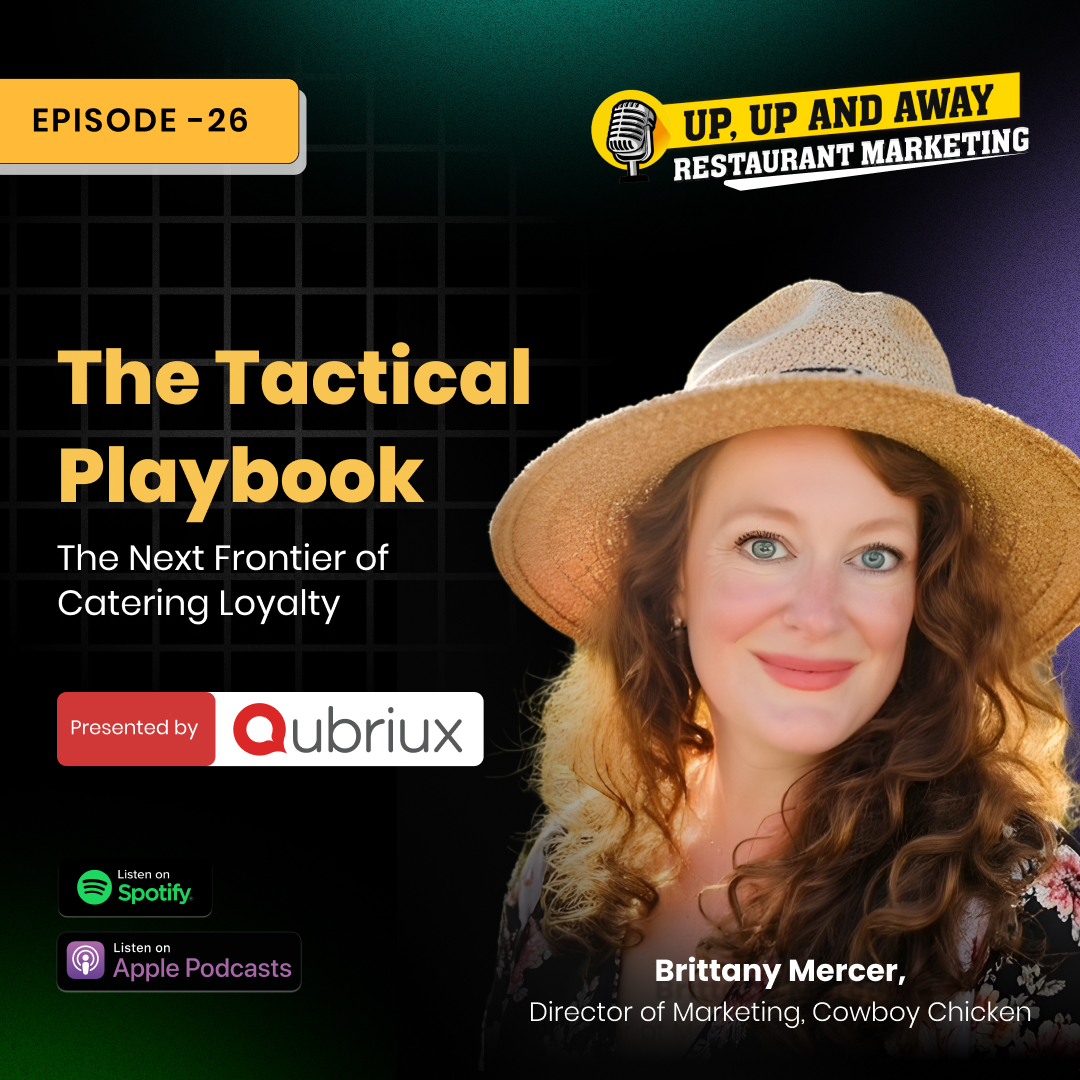
Listen to our deep dive on how to move from reactive order-taking to proactive, data-driven B2B catering pipelines that build true multi-unit customer loyalty.
Behavioral and engagement signals across your app, web, and loyalty program add the early-warning indicators that transactional data misses. App session depth, email and SMS interaction history, loyalty point accrual and redemption patterns, and offer response rates all contribute signals of disengagement well before a customer's transaction frequency drops. The key is capturing recency and depth of engagement, not just surface-level opens or clicks that inflate vanity metrics.
Support and service data is the most underused source in multi-unit attrition models. Refunds, complaints, late delivery events, and low post-visit satisfaction scores often precede churn by weeks. Even a small set of support features materially boosts model accuracy by capturing the why behind behavioral drift, not just the drift itself.
Before any model can run reliably, identity resolution across POS, kiosk, app, and loyalty is non-negotiable. A person who orders at the counter, uses the app twice a week, and redeems loyalty points every other visit should appear as one unified profile, not three separate records. Deduplicating accounts, normalizing fields, and respecting consent preferences per channel is the foundation everything else sits on. In short, for predictive analytics for customers to deliver, you need clean IDs and consistent features.
A 90-day roadmap from pilot to scale
The fastest path to value is narrow scope and a single measurable KPI. In week one, choose one use case: churn prevention, next-visit timing, or spend propensity. Set your baseline metric, your target lift, and your decision thresholds before anything else gets built. Assign a clear owner for both activation and measurement, because prediction without an accountable person in the loop rarely changes behavior.
Weeks two through four are about assembling the minimum viable dataset. Map your POS, loyalty, app, and support data sources, then engineer the core features. Keep the schema simple and repeatable rather than building something too sophisticated to maintain. Many customer analytics platforms offer prebuilt connectors and model-ready feature libraries that can shorten setup for teams without in-house data science.
In weeks four through seven, train a baseline model and validate it against real decisions, not just accuracy metrics. Start with logistic regression or Random Forest, then test XGBoost for predictive performance and stability. Calibrate scores into risk bands that align with your offer economics. In practice, a mildly at-risk customer does not need the same intervention as someone who has been absent for weeks beyond their normal cadence. Tiering interventions helps preserve margin while recovering at-risk customers.
Weeks seven through twelve are about activation and proof. Launch with audience-level holdout groups or geo-level controls so you can measure true incremental lift rather than self-selecting results. Track retention lift, visit frequency, average order value, and CLV impact alongside model performance metrics. Document your governance rules, retraining cadence, and channel frequency caps before you scale to additional locations or use cases.
How to choose the right platform for your brand
The right predictive customer analytics platform for a multi-location brand needs to do four things well: unify data across all touchpoints, run predictive models, activate journeys in real time, and measure true incremental revenue rather than proxy metrics like open rates. If the platform can only do two of those four, you are back to stitching tools together manually, which defeats the purpose.
Point solutions like Amplitude or Mixpanel are strong for digital event analysis and product analytics. Enterprise suites like SAS Viya or Oracle Analytics support complex statistical modeling at large scale. These categories generally are not end-to-end for the prediction-to-activation workflow many multi-unit brands need. If immediate activation and timely incrementality measurement matter, verify that a platform integrates natively with your engagement channels and supports holdouts or geo-tests. Expect tests to run long enough to capture repeat behavior, often multiple weeks, before you declare ROI.
Platforms such as Qubriux provide an integrated option for multi-location brands. QubCore brings POS, kiosk, app, loyalty, CRM, and online ordering data together to build unified customer profiles. QubMind includes out-of-the-box models for churn, next-visit timing, and offer propensity, and it can orchestrate messaging across common channels. Evaluate vendor documentation and case studies to confirm depth of connectors, activation workflows, and incrementality measurement for your use cases.
On the build-versus-buy question: building your own XGBoost pipeline works when you have data science capacity, MLOps infrastructure, and martech orchestration already in place. Most brands do not. When speed, scale, and reliability matter more than fully bespoke models, a unified platform shortens time to value and reduces the maintenance burden that in-house models accumulate over time.
Proving ROI: KPIs, benchmarks, and traps to avoid
The metrics that matter to operators and finance are churn reduction, retention lift, visit frequency, average order value, CLV uplift, and true incremental revenue. Conversion rates and email open rates are supporting signals, not the headline. Finance teams want to see margin and contribution impact per customer, not engagement statistics that do not connect to the P&L. Recent industry insights from Forrester reinforce that legacy strategies fail to prove financial value, making AI-driven analytics necessary to uncover actionable root causes and establish a concrete link between customer retention efforts and financial performance.
Measuring incrementality correctly requires isolating the effect of the prediction-driven campaign from people who would have returned anyway. User-level holdout groups work cleanly for CRM and app-triggered campaigns: assign eligible customers into treatment and holdout before the trigger fires, suppress the message for the holdout group, and compare post-trigger revenue between the two cohorts. For geo-level tests, select markets with similar historical demand and seasonality, run the campaign in treatment markets only, and compare revenue during the test period against matched control markets. Run tests long enough to capture repeat visit behavior, not just one-off redemptions.
The most common operational trap is discount leakage: using high-value offers on customers who were already going to return regardless of incentive. Aligning offer value to actual risk score or propensity band is how you protect margin while still recovering at-risk customers. A related trap is model drift: menus change, seasons shift, and customer behavior evolves, so models need a regular retraining cadence with monitoring alerts for data breaks or performance degradation.
Compliance and consent management need to be embedded from the start, not retrofitted later. TCPA requirements govern SMS outreach in the US, and CCPA applies to customer data handling for California-based customers. Every activation plan should respect consent preferences at the channel level, with clear opt-out handling that feeds back into the unified customer profile automatically.
Where to go from here
The gap between brands that run predictive customer analytics campaigns and those that still rely on calendar-based blasts is widening. Operators who can anticipate customer behavior, time their outreach precisely, and measure real incremental lift compound an advantage with every campaign cycle. The technical barrier has dropped significantly: you no longer need a large in-house data science team to run effective churn and propensity models if the platform handles the heavy lifting.
If you are ready to move from scheduled promotions to behavior-triggered engagement that grows visit frequency and CLV, start by evaluating a platform with proven deployments at scale. Qubriux partners with brands to design pilots, configure models, and connect predictions to activation across the channels your customers use. Moving to predictive customer analytics helps you build a measurable, repeatable revenue system on the customer data you already have.
About Qubriux
Qubriux is a purpose-built Customer Data and Engagement Platform (CDEP) designed to help multi-unit brands turn fragmented customer data into measurable revenue. By unifying data from your POS, loyalty program, and online channels through QubCore, and activating it via QubMind's predictive AI, we empower marketing teams to launch automated, margin-aware personalization at scale. Whether it is predicting churn, optimizing visit timing, or driving incremental spend, Qubriux provides the infrastructure to grow your brand without growing your headcount.